

Many companies currently use blueprints, a valuable design thinking tool that serves as a roadmap for creating exceptional customer experiences, especially in service industries.
In this article, we will explain what this concept is, what it is used for, and how you can effectively create your own interaction map in just a few steps. Are you ready to unlock the secrets of this tool?
What is a blueprint?
As mentioned above, the blueprint is a design thinking tool that allows you to map and visualize the various interactions that occur between a customer and a company during the provision of a service.
Based on this analysis, it is possible to identify critical touchpoints that can be improved and standardize them in order to optimize the services provided and enhance the end customer experience.
What is the blueprint for?
The main purpose of this tool is to help service companies better understand the customer experience, from initial contact to service completion, and how this influences the purchasing experience.
It is also important to note that the blueprint can give you a significant competitive advantage, because by analyzing the competition, you can find flaws in these companies and identify opportunities to innovate and offer a unique selling point.
Why is it important to make a blueprint?
Adopting this tool within your company is important for several reasons:
- 1. Improve Customer Experience: Through the blueprint, your company can identify critical points in the process and adjust them so that customers do not encounter problems and become frustrated.
- 2. Identify Opportunities: It allows you to identify opportunities to innovate and differentiate yourself from your competitors in the market by offering better services.
- 3. Make Strategic Decisions: By conducting an in-depth analysis of all customer interactions, the blueprint allows you to make strategic decisions, improving service quality.
- 4. Process Standardization: In addition, this is a very useful tool for standardizing internal processes, which ensures that your teams are always aligned on the objectives and steps to be taken.
How to create and structure a blueprint?
Now that you know the importance of a blueprint, we will teach you how to make one in practice. Check it out:
1. Identify what will be mapped
First, it is necessary to identify and determine the specific service or process that will be mapped by the blueprint. This is a crucial step in clearly establishing the objectives and goals that need to be achieved.
2. Study your customers
Before you start structuring the blueprint, remember to study your consumers to understand who they are and how they behave, as well as identifying their needs, expectations, and frustrations in relation to your service.
3. Map the touchpoints
The next step is to identify all the points at which the customer interacts with your company in some way. This includes visits to the physical store, phone calls, messages in customer service chats, interaction on social media, use of an app, marketing emails, etc.
By mapping all these touchpoints, the company can gain a clear and comprehensive view of all the stages or interactions that can positively or negatively influence a customer’s shopping experience.
4. Key attributes of the blueprint
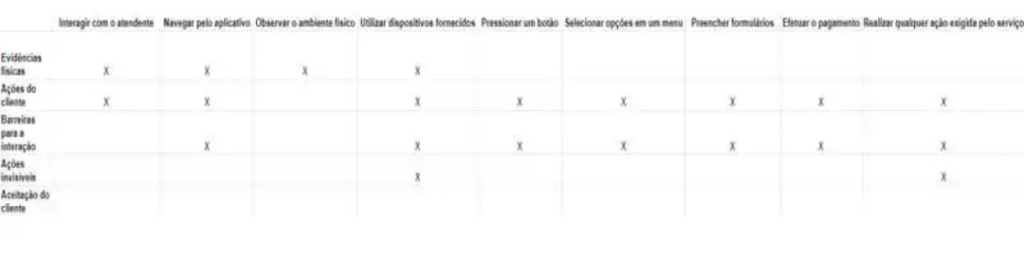
Now, we will create a table outline with some of the main attributes of the blueprint. They are:
- Physical Evidence: This refers to all tangible elements that the customer comes into contact with when interacting with your service. The layout of your company’s app is a good example of physical evidence.
- Invisible Actions: This refers to employee activities that are not visible to customers but are essential, such as the work done by cooks in a restaurant, for example.
- Customer Actions: These are all the actions your customer needs to perform during their journey, such as pressing a button to access a function in the application.
- Interaction Barriers: List all obstacles that can hinder or impede your customer’s interactions with the service. A confusing and unintuitive app interface is one such barrier.
- Customer Acceptance: Indicates the level of stress or satisfaction of your customers in relation to a particular stage of the process.
5. Gather all the information and create a table.
Now that you have all the necessary information, just create a table listing the five attributes of the blueprint for each of the actions your consumers take during each stage of the process.
See the following example:
Have you learned what a blueprint is?
We hope our article has helped you understand what a blueprint is and how this tool can be used to improve all stages of your service, increasing your customers’ satisfaction levels.